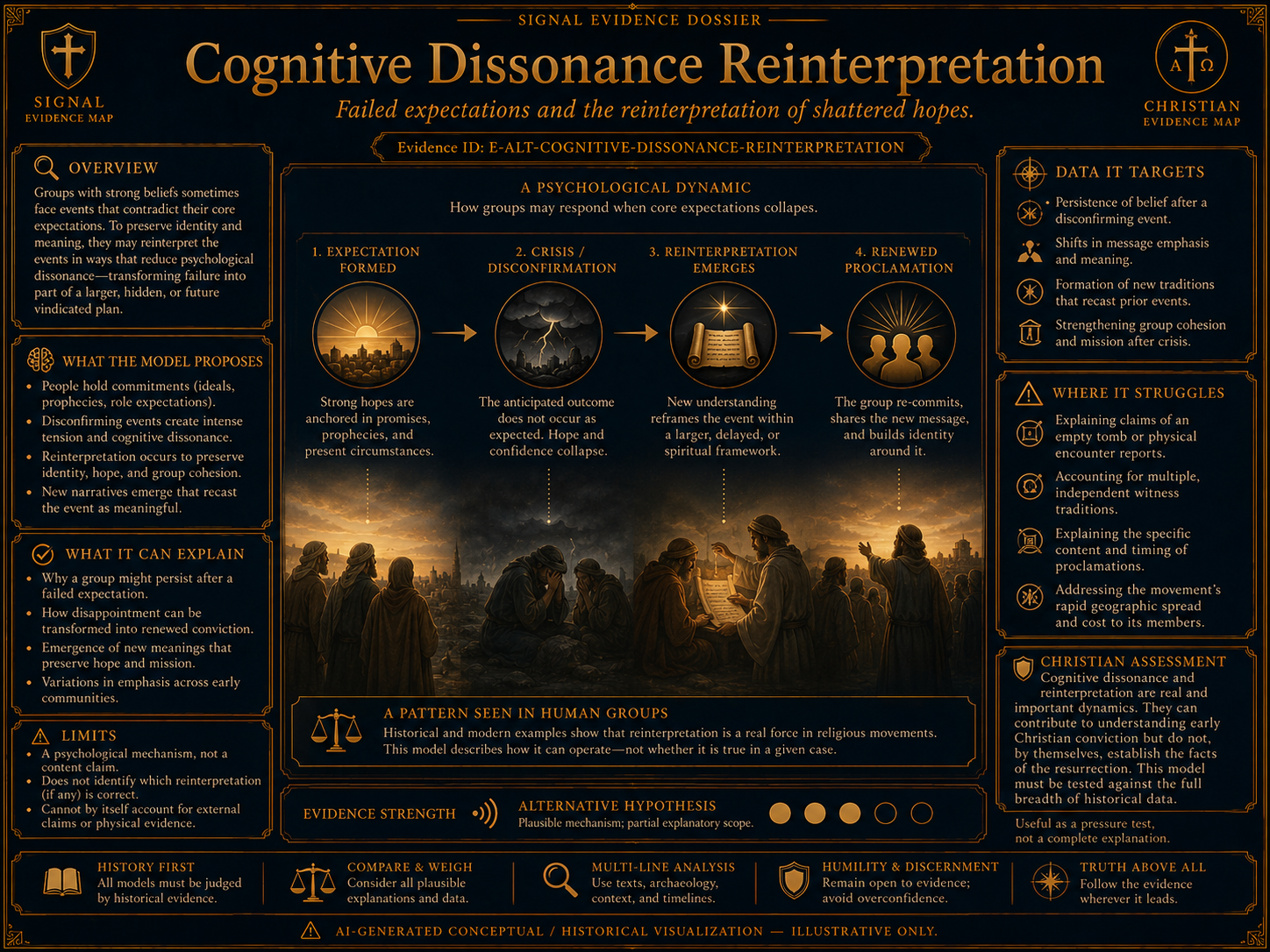
Primary Datum
Datum: Cognitive dissonance and failed-expectation repair can help explain how a crushed messianic movement might reinterpret defeat as vindication.
Dependency / Cap Metadata
- dependency_cluster_id
- resurrection_alternative_explanations
- dependency_cluster_role
- subcase
- dependency_cluster
- resurrection_alternatives
- dependency_role
- child
- cap_profile
- rival_pressure
- evidence_function
- rival_positive
- directness
- supporting
Counter-Pressure
- title
- Cognitive dissonance can preserve a movement; it does not automatically create Resurrection.
- text
- Failed-expectation reinterpretation is a serious mechanism. Human beings do rescue meaning after collapse. But the Christian origin question is more specific: why did a crucified-Messiah disaster become a bodily Resurrection proclamation, tied to witnesses, public preaching, Paul, James, and worship of Jesus? Reinterpretation can explain pressure to continue; it does not by itself explain the shape of what continued.
- path
- Grant that shattered groups reinterpret failure. Then ask why this group reinterpreted in this direction. Why not say Jesus was a martyr, a heavenly teacher, or a vindicated spirit? Why claim God raised Him, and why preach that claim publicly where it could be contested? The model is useful, but it needs historical content, not just psychological possibility.
Apologetic Note
- label
- Rival-pressure use
- title
- Failed-expectation repair is psychologically real.
- key point
- This row has force because communities can reinterpret defeat in ways that preserve identity and hope. A crucified Messiah created exactly the sort of crisis where reinterpretation pressures would matter.
- conversation move
- Let the psychological mechanism stand. Then ask whether reinterpretation alone explains bodily Resurrection language, empty-tomb claims, hostile or skeptical converts, and the public witness structure as well as it explains inner-group survival.
- caveat
- Do not caricature cognitive dissonance as dishonesty. It can be sincere. The question is whether sincerity plus reinterpretation is broad enough for the whole Resurrection data set.
Caveats / Notes
- Source note
- Use Festinger, Riecken, and Schachter for failed-expectation repair. Do not collapse this row into hallucination or treat it as proof of dishonesty.
- Cap notes
- This row preserves failed-expectation and reinterpretation pressure as a psychological alternative. Future cap diagnostics may govern overlap with hallucination and grief-vision rows, but should not hide the objection or treat it as answered by default.
- Cap profile note
- Rival and defeater pressure is capped within its own family and kept visible.
- Scoring note
- Scored directly to H-ALT-COGNITIVE-DISSONANCE with a small Resurrection pressure term.
Machine-Readable Source
This page is generated from the public evidence mirror without recalculating or changing scores.