Evidence Item - v0.7

Hallucination + Cognitive Dissonance as an Alternative

E-ALT-HALL-2

Visual overview: Hallucination and cognitive dissonance alternative visual overview
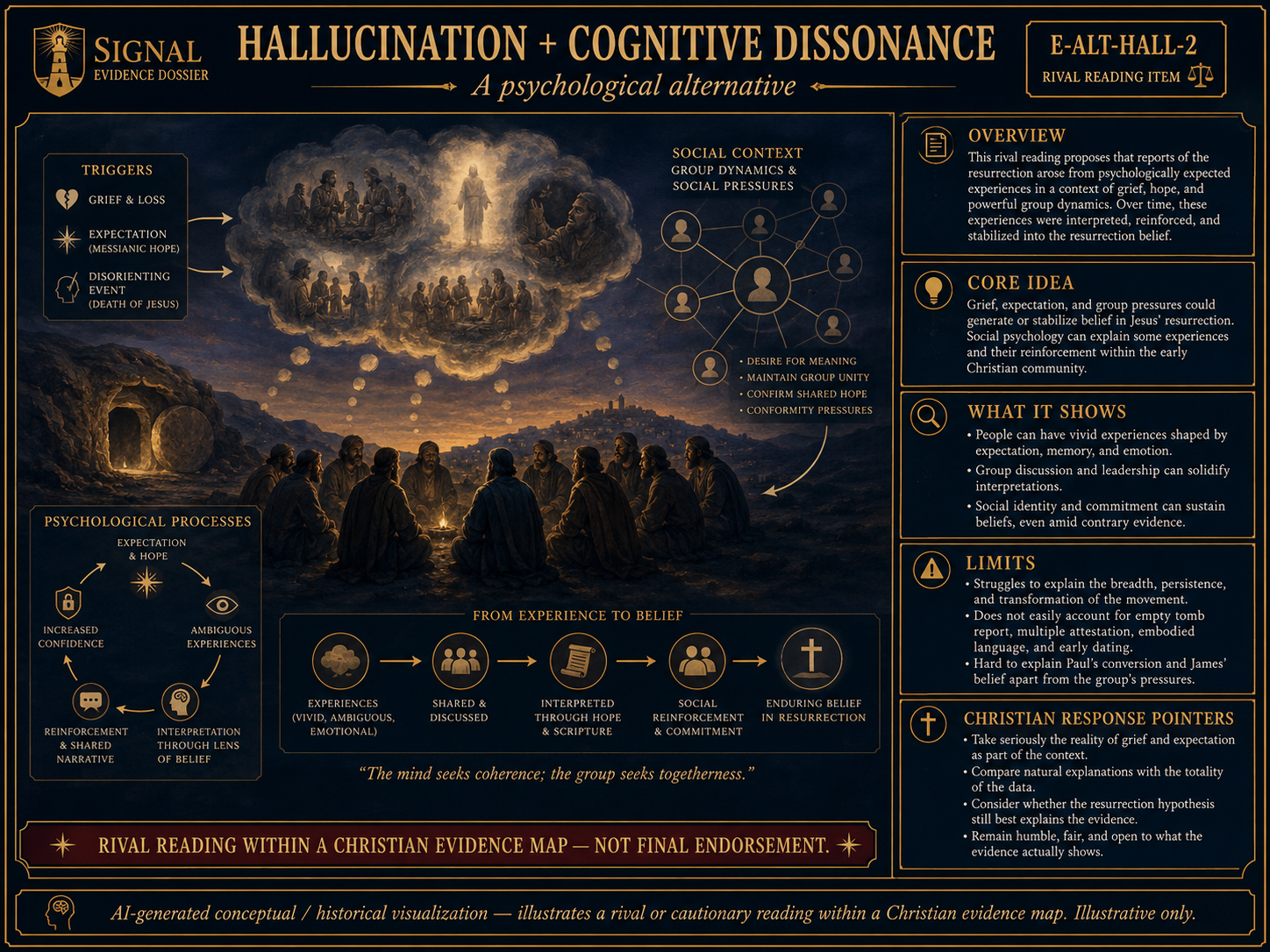
AI-generated conceptual and historical visualization of hallucination and cognitive dissonance as bounded rival explanations for resurrection appearance claims.
AI-generated conceptual / historical visualization — illustrates a rival or cautionary reading within a Christian evidence map. Not a statement of final endorsement.

Classification

Evidence ID
E-ALT-HALL-2
Corpus/version
v0.7
Stage
stage4
Category
Historical Jesus / Alternatives
Major category
History
Sub-category
Alternative Explanations
BF status
ready
Scoring label
Scored row with active Bayes factors

Primary Datum

Datum: Social psychology shows that tightly bonded groups sometimes grow more convinced after disconfirming events.

Scoring / Hypothesis Pressure

Hypothesislog10BFMinMaxRationale
H-ALT-CONSPIRACY0-0.10.1Conspiracy posits deliberate deception; a hallucination route offers a non-deceptive explanation, keeping conspiracy near-neutral overall.
H-ALT-HALLUCINATION0.150.050.25Psychological mechanisms (dissonance, social identity) can plausibly sustain conviction after visionary experiences; steelman positive but conservative.
H-ALT-LEGEND0-0.050.05Legendary accretion is a different pathway; hallucination dynamics neither strongly favor nor disfavor it.
H-ALT-SWOON0-0.10.1A survival scenario is orthogonal to hallucination dynamics; no strong interaction expected.
H-CHRIST-IDENTITY0-0.10.1Identity claims may be reinforced by group processes, but the hallucination model does not uniquely predict high Christological developments.
H-RESURRECTION-0.15-0.25-0.05If hallucination dynamics suffice, the need for a real resurrection diminishes; assign a modest negative band given acknowledged limits of the model.

Dependency / Cap Metadata

dependency_cluster_id
resurrection_alternative_explanations
dependency_cluster_role
primary_anchor
dependency_cluster
hallucination_visionary_experience
dependency_role
anchor
cap_profile
rival_pressure
evidence_function
rival_positive
directness
supporting

Counter-Pressure

title
Psychology can explain experiences; it has trouble explaining the whole Resurrection claim.
text
Hallucination and cognitive-dissonance models deserve a fair hearing. People can have powerful experiences, and groups can reinterpret failure. But the model must do more than explain inner states. It must explain why the earliest message became bodily Resurrection, why the tomb question did not disappear, why Paul and James were persuaded, why the disciples did not merely say Jesus was spiritually alive, and why the movement preached a public act of God rather than a private consolation.
path
Let the psychological model be as strong as possible. Then walk through the evidence one piece at a time: private visions, group claims, empty tomb, hostile conversion, skeptical family conversion, Jewish resurrection categories, public preaching, and worship of Jesus. If the model explains only the first two or three items, say so. A good alternative must preserve the whole field, not only the easiest slice.

Apologetic Note

label
Rival-pressure use
title
The hallucination/dissonance model is the strongest psychological rival lane.
key point
This row has real force because grief, expectation, social reinforcement, and failed-expectation repair are known features of human communities. The Christian case should not pretend the psychological lane is empty.
conversation move
Present it as a serious rival: it can explain some experiences and some group persistence. Then ask whether it also explains empty-tomb claims, bodily Resurrection categories, Paul, James, public proclamation, and the early devotional shift around Jesus.
caveat
Do not make the row a global anti-Resurrection penalty. It is capped because several sub-rows share the same explanatory family.

Caveats / Notes

Cap notes
This row is the main visionary/psychological rival anchor. Future cap diagnostics may govern overlap with grief-vision and cognitive-dissonance rows, but should not hide the objection or turn it into a global anti-Resurrection penalty.
Cap profile note
Rival and defeater pressure is capped within its own family and kept visible.
Cluster note
Hallucination/cognitive-dissonance alternative anchor. Effects are capped against creed, empty-tomb, martyrdom, and worship-practice rows; do not stack as a global anti-resurrection penalty.
Scoring note
Hallucination/cognitive-dissonance alternative anchor. Effects are capped against creed, empty-tomb, martyrdom, and worship-practice rows; do not stack as a global anti-resurrection penalty.
Notes
Normalized to Anthropology / Cognitive Science → Hallucination & Cognitive Dissonance; steelman of hallucination model with clear banding and midpoint log10BF.

Citations

Recommended Citation

The Signal Evidence Dataset, "Hallucination + Cognitive Dissonance as an Alternative," Evidence ID: E-ALT-HALL-2, Version 0.7. Accessed [access date]. https://logos-signal.org/evidence/E-ALT-HALL-2/

Machine-Readable Source

This page is generated from the public evidence mirror without recalculating or changing scores.