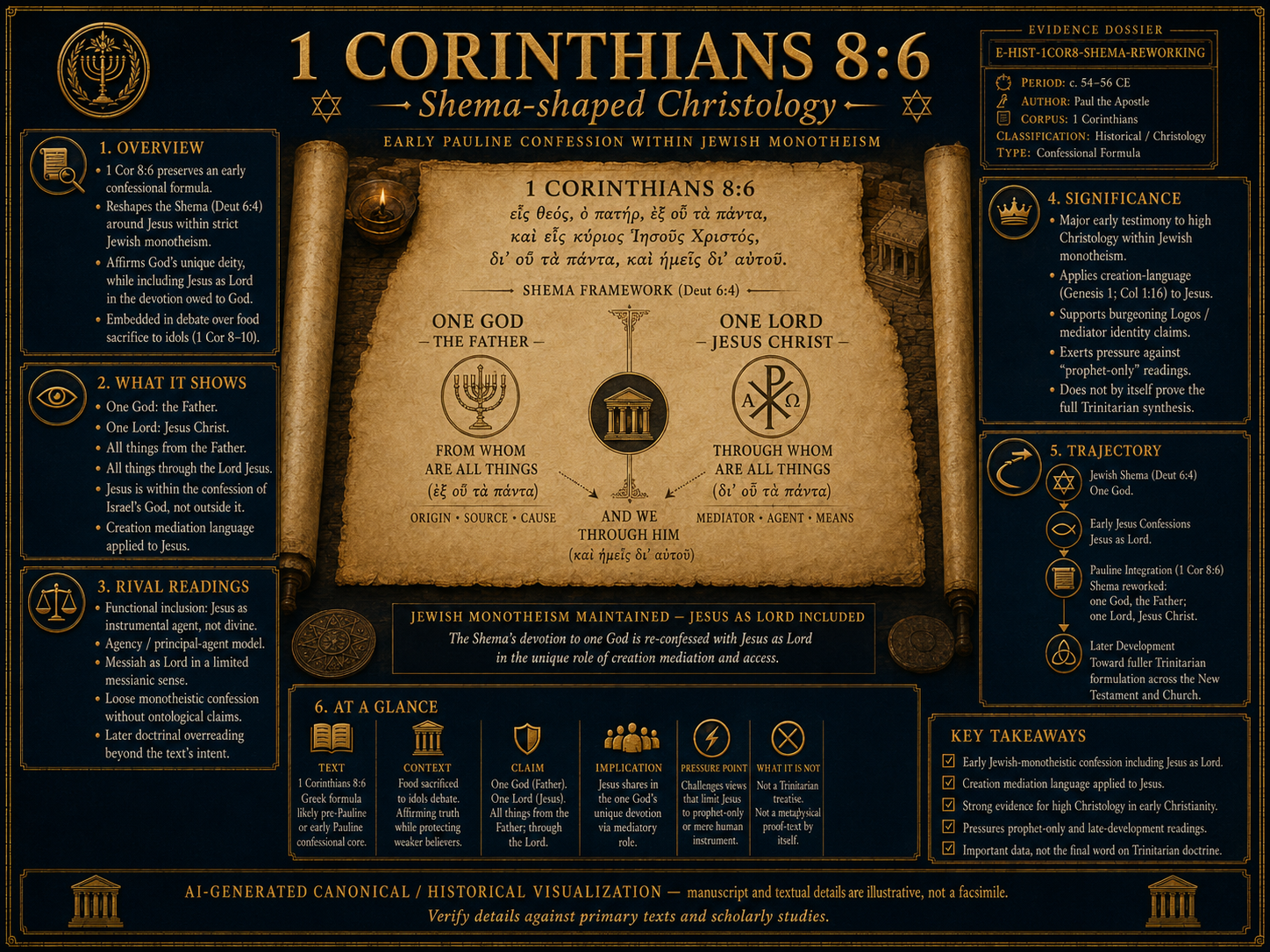
Primary Datum
Datum: 1 Corinthians 8:6 places Jesus inside a confession shaped by Jewish monotheism and creation mediation language.
Dependency / Cap Metadata
- dependency_cluster_id
- shema_monotheism_reworked_around_jesus
- dependency_cluster_role
- primary_anchor
- dependency_cluster
- early_high_christology_worship
- dependency_role
- anchor
- cap_profile
- moderate_semi_independent
- evidence_function
- direct_identity
- directness
- direct
Counter-Pressure
- title
- Shema reworking is powerful, but it still needs careful reading.
- text
- The strongest objection says Paul may be using functional, agency, or Messianic Lordship categories rather than making a direct ontological claim. That pressure is real. The Christian answer is not to skip the debate, but to ask why Jesus appears inside this kind of monotheistic confession so early.
- path
- Grant the rival readings first. Then keep the whole pattern together: 1 Corinthians 8, Romans 10, Philippians 2, Maranatha, prayer/invocation, baptismal-name practice, Hebrews 1, John 1, and Resurrection proclamation. One row is not the full case; the convergence is the case.
Apologetic Note
- label
- Apologetic leverage
- title
- 1 Corinthians 8 asks why Jesus appears inside Shema-shaped confession.
- key point
- The row is not generic theism. It is early, Christ-specific pressure: Paul can speak of one God and one Lord in a way that places Jesus inside the grammar of confession, creation, and allegiance shaped by Jewish monotheism.
- conversation move
- Grant that agency, functional inclusion, and Messianic Lordship readings matter. Then ask whether they can carry the whole pattern when 1 Corinthians 8 is read beside Romans 10, Philippians 2, Maranatha, prayer/invocation, baptismal practice, John 1, Hebrews 1, and Resurrection proclamation.
- caveat
- This row does not prove the Trinity by itself, does not directly score the Resurrection, and must remain dependency-capped with the wider early high Christology cluster.
Scripture Passage
prophecy: label: Shema / source confession; reference: Deuteronomy 6:4; fulfillment: label: Pauline Christological reworking; reference: 1 Corinthians 8:4-6
Caveats / Notes
- Source note
- Primary texts are 1 Cor 8:4-6 and Deut 6:4. Source review should use Bauckham and Hurtado for the positive divine-identity / early-devotion reading, and Gaston/Perry plus broader developmental-Christology scholarship as counterpressure. Any future BF must disclose whether it treats 1 Cor 8:6 as a conscious Shema reworking, a looser monotheistic confession, or a contested bridge from early high Christology to Logos synthesis.
- Cap notes
- 1 Corinthians 8:6 is the primary Shema-reworking row, but it overlaps with Romans 10, Philippians 2, Maranatha, prayer/invocation, baptismal-name practice, YHWH-text application, Pauline high Christology, and strict-monotheism rival pressure. Preserve row visibility while capping combined positive force.
- Cap profile note
- Semi-independent convergence rows are capped, but not treated as exact duplicates.
- Cluster note
- Primary anchor inside the Shema monotheism reworked around Jesus / early high-Christology / YHWH-text / Pauline worship-practice cluster; do not stack freely with E-HIST-ROM10-JOEL-JESUS, E-HIST-PHIL2-HYMN, E-HIST-MARANATHA-INVOCATION, E-HIST-PRAYER-INVOCATION-JESUS, E-HIST-EARLY-BAPTISM-NAME, or other divine-name/Scripture-application rows. No Resurrection BF applied.
- Scoring note
- v0.4 enrichment left active BF values unchanged. Capped Shema-reworking / early high-Christology support; no Resurrection BF applied. Any future BF movement should happen only through row-level or cluster-level review.
- BF review note
- BF values were not changed in this enrichment. Later review should happen at the Shema / YHWH-text / early devotional cluster level after sibling rows are fully enriched.
Machine-Readable Source
This page is generated from the public evidence mirror without recalculating or changing scores.