Primary Datum
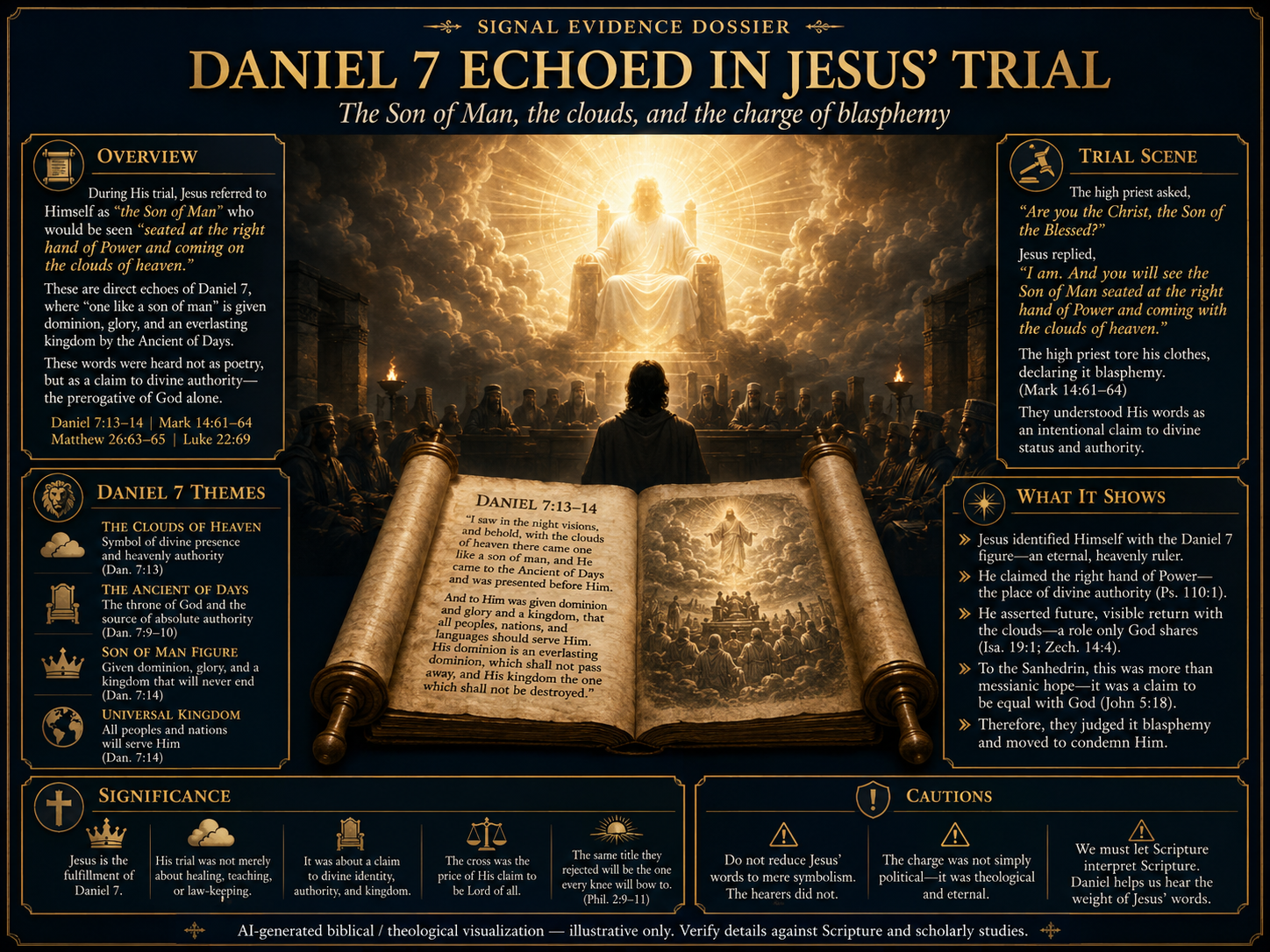
Datum: The trial, blasphemy, and temple-charge tradition frames Jesus' final conflict as an authority and identity dispute before God.
Dependency / Cap Metadata
- dependency_cluster_id
- son_of_man_divine_court
- dependency_cluster_role
- sibling_support
- dependency_cluster
- synoptic_divine_prerogatives
- dependency_role
- child
- cap_profile
- moderate_semi_independent
- evidence_function
- direct_identity
- directness
- direct
Counter-Pressure
- title
- The trial tradition is historically complex and must not be overplayed.
- text
- The strongest objection says the trial scene may be shaped by Markan theology, political conflict, prophetic temple critique, or uncertain legal reconstruction rather than a clean divine-identity claim. That objection should be granted where it has force. The Christian answer is cumulative: why does Passion memory place Jesus at the intersection of temple authority, blasphemy pressure, Psalm 110, Daniel 7, and Son of Man vindication?
- path
- Keep the row restrained. Acknowledge uncertainty about procedure and wording. Then connect the dots carefully with temple authority, Son of Man judgment, divine-court background, forgiveness of sins, Resurrection proclamation, and early devotion to Jesus.
Apologetic Note
- label
- Apologetic leverage
- title
- The trial scene asks why Jesus' final conflict turns on temple and divine authority.
- key point
- This is Christ-specific evidence, not generic theism. The Passion tradition remembers Jesus' final conflict around temple authority, blasphemy pressure, and Son of Man vindication. That pressures accounts where Jesus is only a harmless moral teacher.
- conversation move
- Do not claim the trial alone proves the Trinity. Grant legal-historical uncertainty, Gospel shaping, political conflict, and prophetic-symbolic readings, then ask whether those readings can carry the whole pattern when this row is set beside Son of Man judgment, divine-court background, temple authority, forgiveness of sins, Resurrection proclamation, and early devotion to Jesus.
- caveat
- This row is not direct Resurrection evidence, not a verbatim trial transcript claim, and never a basis for collective blame. It belongs to a cumulative, dependency-capped Christ Identity cluster.
Scripture Passage
prophecy: label: Scripture background; reference: Psalm 110:1; Daniel 7:13-14; fulfillment: label: Trial claim and charge; reference: Mark 14:53-65
Caveats / Notes
- Source note
- Primary review texts are Mark 14 trial material with Psalm 110 and Daniel 7 links, plus temple-charge tradition. Existing citations provide the current source spine; future review may add precise trial-history, Passion-tradition, or temple-action citations rather than inventing unsupported publication details.
- Cap notes
- Trial/blasphemy and temple-charge material adds a Passion-context strand, but it overlaps with Son of Man judgment authority, divine-court background, temple authority, Daniel 7, Psalm 110, and broader Synoptic divine-prerogative rows. Preserve row visibility while capping shared-source force.
- Cap profile note
- Semi-independent convergence rows are capped, but not treated as exact duplicates.
- Cluster note
- Trial, blasphemy, and temple-charge material is a Christ Identity support lane. Do not stack freely with E-HIST-DIVINE-COURT-SON-MAN, E-HIST-SON-MAN-JUDGMENT, E-HIST-TEMPLE-AUTHORITY-REPLACEMENT, Daniel 7 material, Psalm 110 material, or Synoptic divine-prerogative rows.
- Scoring note
- v0.4 enrichment left active BF values unchanged. Scored in the Synoptic divine-prerogatives lane as dependency-capped Christ Identity evidence; no Resurrection BF applied. Any future BF movement should happen only through row-level or cluster-level review.
- BF review note
- BF values were not changed in this enrichment. Later review should happen at the Son of Man / divine-court and Synoptic divine-prerogatives cluster level after sibling rows are enriched.
Machine-Readable Source
This page is generated from the public evidence mirror without recalculating or changing scores.