Evidence item · v0.74

Large moon stabilizes Earth’s obliquity

E-MOON-OBLIQUITY

Visual overview: Moon obliquity stability visual overview
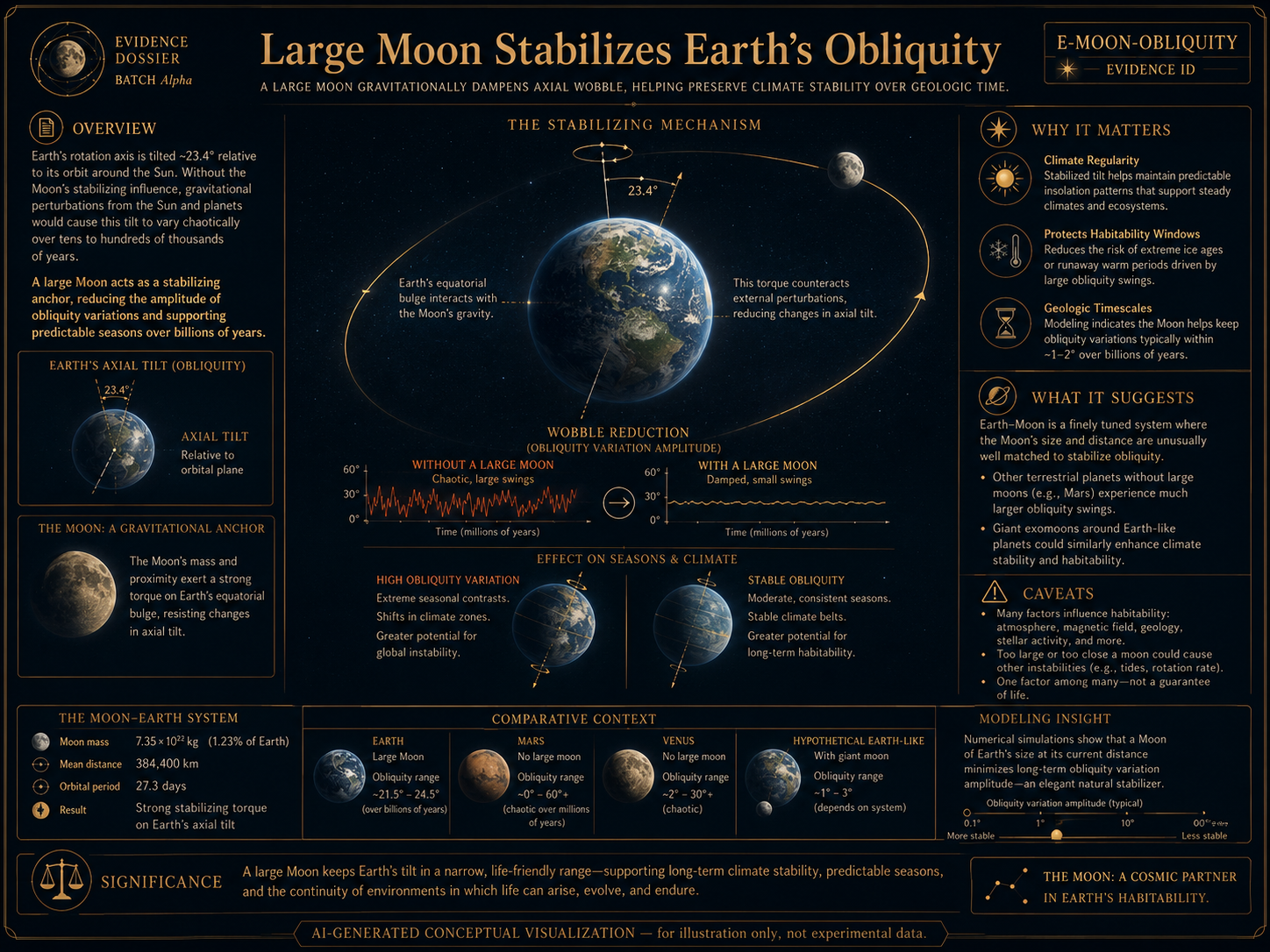
AI-generated conceptual visualization of the Moon stabilizing Earth's axial tilt, showing lunar gravity, obliquity, seasons, climate stability, and planetary habitability.
AI-generated conceptual visualization — for illustration only, not experimental data.

Classification

Evidence ID
E-MOON-OBLIQUITY
Corpus/version
v0.74
Stage
stage2
Category
Fine-Tuning
Major category
Science
Sub-category
Habitability Conditions
BF status
ready
Scoring label
Scored row with active Bayes factors

Primary Datum

Datum: Earth's large moon helps stabilize axial tilt, moderating long-term seasonal and climate variation.

Scoring / Hypothesis Pressure

Hypothesislog10BFMinMaxRationale
H-DEISM0.05-0.099999999999999990.2Large moon stabilizes Earth’s obliquity nudges Deism upward because it fits an ordered cosmos without yet requiring a revealed or covenantal God. The effect is limited because the clue is broad and does not prove Deism by itself.
H-GOD0.1-0.049999999999999990.25Large moon stabilizes Earth’s obliquity nudges God upward because it fits a reality with deep order, intelligibility, or purpose. The effect is limited because rival explanations remain possible, and this row does not prove God by itself.
H-GOD-OT0-0.150.15Large moon stabilizes Earth’s obliquity does not clearly pick out the God-OT frame from broader theism. It stays neutral because the row lacks enough biblical or covenant detail to prove that view.
H-IDEALISM0-0.150.15Large moon stabilizes Earth’s obliquity does not clearly separate Idealism from other accounts of order and structure. It stays neutral because the clue can be read without settling what is most basic in reality.

Dependency / Cap Metadata

dependency_cluster_id
habitability_rare_earth
dependency_cluster_role
support_layer
dependency_cluster
habitability_rare_earth
dependency_role
support_layer
cap_profile
support_layer_small
evidence_function
context_child
directness
supporting

Counter-Pressure

title
Large moon stabilizes Earth’s obliquity is a bounded signal, not a standalone proof.
text
The strongest caution is overuse. Habitability rows overlap heavily and should not be stacked as if every condition were fully independent. This row should be read inside its dependency family, not treated as an isolated demonstration of God, Christ, or the final synthesis.
path
Start with what the row actually shows, then name what it does not show. Use it as part of a layered habitability pattern, while granting that natural selection cannot operate until a habitable arena already exists.

Apologetic Note

label
Apologetic leverage
title
Large moon stabilizes Earth's obliquity is a clue inside an intelligible, life-bearing order.
key point
The Moon damps chaotic obliquity variations; stabilizes seasons and climate. The point is not that mechanisms fail. It is that mechanisms, information, constraints, and repeatable life-building patterns live inside an intelligible order.
conversation move
Say it plainly: science can describe how a process unfolds, and Christians should welcome that. The larger question is why there is a lawlike, information-rich, life-bearing world for such processes to unfold in.
caveat
Do not make a God-of-the-gaps move. Let mechanisms explain what they explain, then ask whether mechanism alone explains the whole field.

Caveats / Notes

Cap notes
Rare-Earth/habitability support is capped as a related fine-tuning family.
Cap profile note
Child/support rows in broad science families are capped as support, not independent root proofs.
Governance note
Capped as habitability support, not independent root-metaphysics stacking.

Citations

Recommended Citation

The Signal Evidence Dataset, "Large moon stabilizes Earth’s obliquity," Evidence ID: E-MOON-OBLIQUITY, Version 0.74. Accessed [access date]. https://logos-signal.org/evidence/E-MOON-OBLIQUITY/

Machine-Readable Source

This page is generated from the public evidence mirror without recalculating or changing scores.